What do my skill scores mean?
Last updated: June 22, 2026
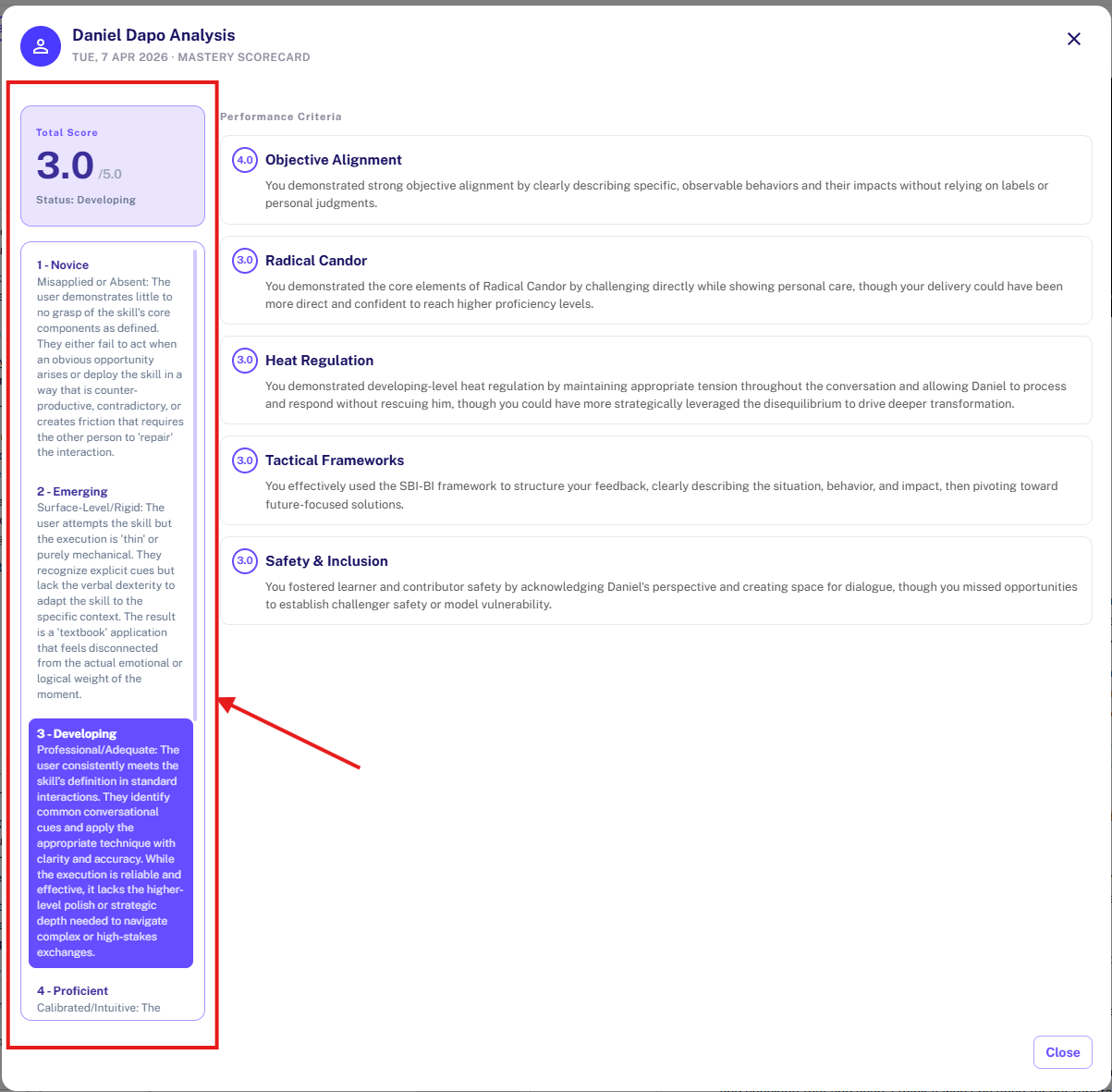
Every meeting and roleplay session is scored against the criteria defined in your skill — scores run from 1 (Novice) to 5 (Master) and reflect how well you applied the skill in that specific conversation.
The five scoring levels
Each skill uses a five-level mastery scale:
1 — Novice: The skill is misapplied or absent. The conversation shows little grasp of the skill’s core logic.
2 — Emerging: Surface-level or mechanical execution. You recognise the cues but the application feels rigid.
3 — Developing: Consistent and accurate, but lacking the polish or strategic depth needed for high-stakes conversations.
4 — Proficient: High-fidelity execution. You adapt to subtle cues and know when — and crucially, when not — to deploy the skill.
5 — Master: Seamless, transformative application. The skill is woven naturally into how you communicate.
How the overall score is calculated
Your overall score is the average of the individual criterion scores for that session. Each criterion reflects a specific behavior the skill measures; for example, a skill might score you separately on how you opened the conversation, how you handled pushback, and how you closed.
A score of “No Score” means the session did not contain enough data to evaluate that criterion. This is common in short or incomplete sessions.
What the score badge and progress bar show
On your skill card and inside the skill view, you’ll see two score badges, one for Meetings and one for Roleplays. Each badge shows your most recent overall score for that session type.
The small chart (sparkline) next to each badge shows your score trend over time. The Y-axis always represents the full scoring range (1–5), so you can see your progress in context, not just relative to your own best session.
The progress bar in the score tooltip uses dots to mark each level. Hover over a dot to see the label for that level (e.g. Developing, Proficient).
Why are my scores shown with decimals?
Average scores for meetings and roleplays now show their precise value, to two decimal places, instead of being rounded to the nearest half point.
Previously, average scores were rounded to the nearest 0.5, which could hide real progress. A score of 2.74 and a score of 2.76 might both have looked very different once rounded, even though the difference between them was tiny.
Scores display to two decimal places, so small improvements in your performance show up clearly. For example, you might see 3.26 rather than 3.5.
The way your performance is assessed has not changed. Only how precisely the score is displayed has changed, so you get a clearer view of your progress over time.